With my partner Aidan, I created a short dark comedy film called 'Advanced Car Hit', which follows the story of a nerdy teenager who is dumped by his girlfriend, Lisa, stalks her with the intention of killing her as revenge, but is stopped when she is hit by a car instead. Rather than being upset by her timely death, the nameless protagonist is delighted that justice has been served. Before making my video, I watched existing short films, both professional and student-made, to help inspire me and ensure that I knew the conventions of the type of film I was making. One of the things that we took into consideration when creating our film was using the micro-elements to create meaning. My role in the film making process was camerawork and special effects editing, whilst Aidan dealt with the scriptwriting and craft editing. We shared the job of directing between the two of us.
Throughout the film we tried to vary the distance and angles of shots to encode meaning that the audience could decode, as well as demonstrating our technical ability. We filmed the entire film on two cameras, both Canon 550Ds, allowing us to shoot in shallow focus to draw attention to different aspects of the shot. The film begins with a close-up shot of a park gate whilst the protagonist approaches, slowly coming into focus, until he too is in the close-up. This shot introduces the audience to both the setting - acting as a establishing shot - and the boy, ensuring that he is represented as the main character, and not Lisa. The following shot of Lisa sat at the park bench further establishes the scene and also introduces her character too. Throughout their conversation we used close-ups and point-of-view shots to display the actors' emotions: Lisa's discomfort and boy's ignorance to it. It also created an intimacy in this scene that heightens the comedic performance given by the main character. Close-ups were also used later in the film to highlight the characters' actions, such as when the protagonist picks up a large stick. Additionally there are examples of over-the-shoulder shots to show both the foreground and background action in a single take. When he begins to stalk Lisa, a continuous tracking shot was used to build tension as he approaches her and provoke a somewhat worried reaction in the audience.
The mise-en-scene of the film was also vital when creating meaning for the audience. The protagonist was dressed in a tweed jacket, bow tie, paisley shirt, and over sized spectacles to connote the stereotype of a nerd that would be recognised as soon as he appeared on screen. The character of Lisa presents a contrasting image by dressing in stylish, feminine clothes and jewellery that ensure she is seen as conventionally beautiful. The lighting throughout is high key and natural, although towards the end of the film it becomes darker as the characters walk through some trees, suggesting the darker turn that the narrative has taken. The setting of a park was chosen because it is typically romantic due to the bright colours and imagery of flowers and sunshine, which accentuates the morbid ending.
In terms of the sound of the film, it is relatively dialogue-heavy in the beginning, where the audience learn of the situation and the relationship between the two characters due to the conversation they are having. Diagetic sound of birdsong was also recorded in order to set the scene further and create an idyllic atmosphere which contrasts with the protagonist's devastation, meaning that although the subject matter is negative, it is dealt with in a lighthearted manner. In the opening shot, 'Peter and The Wolf March' by Prokofiev is used as it introduces the film as light, which is in stark contrast with the final scene. In addition, sound is used to create humour such as when the protagonist is mourning the end of his relationship and the song 'Time After Time' by Cyndi Lauper is used. Again this ensures that rather than feeling sympathy for him, the audience should find his display of emotion excessive and entertaining, as enforced by the record scratch used to end the song. Another example of using sound to create meaning is when the audience The final song that is featured is 'Battle Without Honour or Humanity' by Tomoyasu Hotei, both during the protagonist's pursuit of Lisa, and again after the car hit. The use of this song not only presents the protagonist as an evil, twisted character, but also creates a contrast between the slick, cool music and the image of the nerdy character, adding to the humour.
The film is shot in real time with continuity editing and regular cuts - done on Adobe Premiere Pro - as this is conventional for such a narrative because it helps to tell the story. The protagonist was privileged in the editing process to highlight his role in the plot; it is clear that his character is more important to the audience than Lisa's, although he is not necessarily supposed to be likeable. I created the car hit at the end of the film on Adobe After Effects, which involved cutting out Lisa's body, using the puppet pin tool to warp her figure, and create key frames of her moving along with the car. I later sped this up in Adobe Premiere Pro as we wanted the death to be as sudden as possible, in order to shock the audience.
Although I am pleased with the way in which the film uses these micro-elements to connect with the audience, we did face some difficulties when it came to time management. Due to the fact that we changed our ideas several times in the planning stages, we were not left with that much time to shoot and edit the film. However, we still managed to follow our plan and included all the things that we had hoped to.
Tuesday, 1 May 2012

Wednesday, 29 February 2012
To what extent are Hollywood films simply 'products' made to make profit?
- Hollywood rarely produces films that are original ideas, especially of late. Instead they are often prequels/sequels to existing films, based on book/comic/tv programme, a remake, a reboot, etc. This ensures that there is already an established audience that will be prepared to see the film whether it is good or not. A perfect example of this is Sex and the City 2.
- Yes it may be true that Hollywood films are made to produce money, but isn't that to be expected? The film business is exactly that: a business. So, like any business they need to make money to continue making products, and just because a film has been made with profit in mind, that does not mean it is going to be a bad film. Hollywood has always been that way because it needs to be that way.
- This means that the big Hollywood companies can use that money to fund subsidiary companies that invest in low-budget, arty films; you need the 'products' to have the money for the 'films'.
Tuesday, 31 January 2012
Sundance film festival hands prizes to 'dark and grim' films
Beasts of the Southern Wild, The Surrogate and The House I Live In among challenging award-winners at 2012 festival
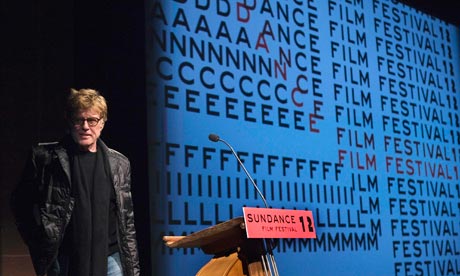
Robert Redford described the tone of this year's Sundance festival as 'dark and grim'. Photograph: Lucas Jackson/Reuters
A Louisiana-set drama about a father and his daughter threatened by the impact of global warming, the autobiographical tale of a man's quest to lose his virginity despite living out much of his life in an iron lung and a polemical documentary targeting America's war on drugs were among the top prize-winners as the Sundance film festival reached its denouement at the weekend.
Beasts of the Southern Wild, the story of a six-year-old girl living with her dad in the flood-threatened basins near the Mississippi delta, won both the jury prize for best US drama and a cinematography prize. Benh Zeitlin's film features a cast of non-actors and has been praised by the Guardian's Damon Wise as "the first significant eco-threat movie to be seen through the eyes of the generation that has inherited global warming".
The Surrogate, which is based on the autobiographical writings of journalist and poet Mark O'Brien, won the US drama audience award and a special jury prize for the acting of its cast. The film, which details the efforts of a 38-year-old semi-paralysed polio victim (Martha Marcy May Marlene's John Hawkes), to embark on a sexual awakening via a "sex surrogate" played by the Oscar-winning actor Helen Hunt, has already picked up one of the festival's most lucrative distribution deals in the form of a $6m sale to studio Fox Searchlight. Jeremy Kay called it "an unexpected crowd-pleaser" with a "mesmerising" performance from Hawkes and tipped the latter for Oscars glory in 2013.
The House I Live In, which documents the failure and the fallout for impoverished areas of America's war on drugs, won the documentary grand jury prize. Speaking at Saturday's awards ceremony, director Eugene Jarecki labelled authorities' battle against the drug trade "tragically immoral and so heartbreakingly wrong and misguided". Citing the large number of unfair drug penalties affecting minorities, as well as the country's high prison population, he said the war was "a terrible scar on America". The US documentary audience award went to another controversial piece, Kirby Dick's The Invisible War, which exposes the high number of instances of rape and sexual assault in the US military. Both films reflected the "dark and grim" tone of this year's Sundance, described by founder Robert Redford, who had warned during the festival's launch that this year's crop of movies mirrored current US travails. Ai Weiwei: Never Sorry, Alison Klayman's film about the renowned Chinese artist and activist's increasingly public clashes with the Chinese government, won the US documentary special jury prize.
Outside the competition, there was British success for Oscar-winning UK film-maker James Marsh, whose film Shadow Dancer was well-received. It tells the story of an Irish mother from an IRA-supporting family who is encouraged to become an informant by MI5. Starring Clive Owen and Andrea Riseborough, it was described by Wise as a "film that will surprise those who know Marsh only from his docs – the Oscar-winning Man on Wire and Bafta-nominated Project Nim – and also cement the director's reputation as one of the UK's leading auteurs".
Sundance, which was founded as the Utah/US film festival in Salt Lake City in August 1978 and took on its present moniker in 1991 following several years of Redford's involvement and sponsorship, has become known as the premier US event for independent film-making. Recent years have seen films such as An Education, Precious and Little Miss Sunshine, all of which screened at the festival, go on to win major awards.
Full list of Sundance winners
Grand jury prize, documentary: The House I Live In
Grand jury prize, drama: Beasts of the Southern Wild
US directing award: The Queen of Versailles, Lauren Greenfield
US directing award: Middle of Nowhere, Ava Duvernay
Waldo Salt screenwriting award: Safety Not Guaranteed, Colin Trevorrow
Audience award, US documentary: The Invisible War
Audience award, US dramatic: The Surrogate
Special jury prizes, US documentary: Love Free or Die and Ai Weiwei: Never Sorry
US dramatic special jury prize for producing: Jonathan Schwartz and Andrea Sperling, Smashed and Nobody Walks
US dramatic special jury prize for Ensemble Acting: The Surrogate
Shorts audience award: The Debutante Hunters
Excellence in cinematography, US documentary: Chasing Ice
Excellence in cinematography, US dramatic: Beasts of the Southern Wild
US documentary editing award: Detropia
Best of next award: Sleepwalk With Me
Alfred P Sloan feature film prize: Robot and Frank and Valley of Saints
World cinema jury special prize, Documentary: Searching for Sugar Man
World cinema documentary editing: Indie Game: The Movie, Lisanne Pajot and James Swirsky
World cinema jury prize,documentary: The Law in These Parts, Ra'anan Alexandrowicz, director
World cinema dramatic special jury prize: Can, Rasit Celikezer, director
World cinema cinematography award, drama: David Raedeker, My Brother the Devil
World cinema cinematography award, documentary: Lars Skree, Putin's Kiss
World cinema directing award, documentary: Emad Burnat and Guy Davidi, 5 Broken Cameras
Shorts audience award: The Debutante Hunters, Maria White, director
World cinema audience award: Searching for Sugar Man
Visions of Ecstasy cleared for release after 23 years
Short film banned for 'blasphemous libel' since 1989 finally gets classification from BBFC
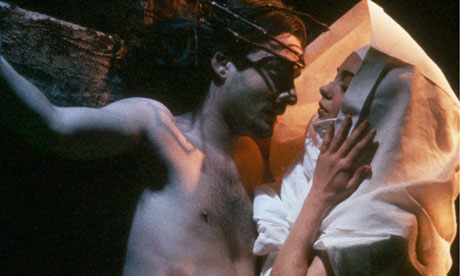
Visions of Ecstasy features a scene where St Teresa of Avila caresses Christ's body on the cross.
The controversial short film Visions of Ecstasy has been given an 18 certificate by the British Board of Film Certification (BBFC), after being denied one for 23 years and becoming the only film banned in Britain for "blasphemous libel".
Visions of Ecstasy contains a scene, as the BBFC describes it, "in which a figure representing St Teresa of Avila interacts sexually with a figure representing the crucified Christ". This was enough for it to fall foul of the Video Recordings Act 1984 (designed to take "video nasties" out of the market place), and the film, directed by Nigel Wingrove, subsequently became a cause celebre for censorship campaigners, but ended in failure at the European Court of Human Rights in 1996.
However, the BBFC remained inflexible until 2008, when the Criminal Justice and Immigration Act abolished the blasphemy and blasphemous libel offences. Wingrove was invited to resubmit his film. He told the Guardian at the time: "I was gobsmacked by the reaction. I can see why some people might have been offended, but it was pretty mild stuff really."
Wingrove told AP that the furore had destroyed his aspirations as a film-maker: "It was my second self-financing film and had it not been banned I would have continued to make films, but that all got knocked sideways and had a huge impact on my career."
Wingrove subsequently set up the video distribution label Redemption Films, which specialises in occult and fetish horror.
Wednesday, 4 January 2012
2012 in the arts: will it be a cultural triumph or a gloriously British disaster?
While 2011 was all about cuts, the arts community puts its best foot forward in 2012 as the Olympics come to London
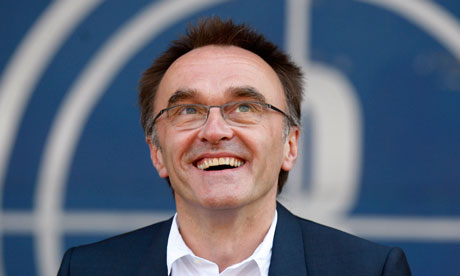
People will be waiting to see if director Danny Boyle's Olympic £80m opening ceremony beats Beijing's 2008 display. Photograph: Sang Tan/AP
The arrival of the Olympics in London will mean that British culture is on show like never before. Commentators will be poring over what these headline events say about us as nation, whether they were planned to tie in with the Games or not.
It's a landmark year for three indie institutions. In April, NME is 60. Three months later, the music weekly is scheduled to meet with Morrissey in the high court over claims that a 2007 interview smeared him as a racist. Light relief will be provided by the almost simultaneous reappearance of some other Mancunian music heroes, the Stone Roses – their gigs will be the pop events of the summer, especially in the absence of Glastonbury.
This year involves major shows from the UK's most famous artists. David Hockney kicks things off in January with a selection of massive landscape paintings at the Royal Academy in London and around Yorkshire, his home county. Tate Modern's Damien Hirst retrospective will feature his most talked-about work, from the shark to the diamond skull. Elsewhere, exhibitions of work by Lucien Freud, Jeremy Deller and JMW Turner will stake a claim for Britain's mastery at the installation and easel – or at least our enduring flair for subversion and self-mockery.
Covent Garden stages Wagner's Ring Cycle in September for the first time in three years. However, the performance with most lasting impact is set to be in Scotland. Since 2008, children in the deprived estate Raploch in Stirling have received intensive tuition in a classical music education programme based on the famous Venezuelan El Sistema.
In June, El Sistema's conductor Gustavo Dudamel and the Simón Bolívar Youth Orchestra, will spend four days working in Raploch with their orchestra Big Noise, culminating in an unmissable performance at Stirling Castle.
The Olympics opening ceremony
Directed by Danny Boyle, in November this extravaganza had its budget doubled to more than £80m – either an encouraging sign or an extremely bad one. It was thought impossible to top Beijing's opening ceremony, but the ballooning costs have raised the stakes vertiginously. Could either be a triumph, or that most British of things – a glorious disaster.Indie's past comes back to haunt it
It's a landmark year for three indie institutions. In April, NME is 60. Three months later, the music weekly is scheduled to meet with Morrissey in the high court over claims that a 2007 interview smeared him as a racist. Light relief will be provided by the almost simultaneous reappearance of some other Mancunian music heroes, the Stone Roses – their gigs will be the pop events of the summer, especially in the absence of Glastonbury.
A big year for Britart
This year involves major shows from the UK's most famous artists. David Hockney kicks things off in January with a selection of massive landscape paintings at the Royal Academy in London and around Yorkshire, his home county. Tate Modern's Damien Hirst retrospective will feature his most talked-about work, from the shark to the diamond skull. Elsewhere, exhibitions of work by Lucien Freud, Jeremy Deller and JMW Turner will stake a claim for Britain's mastery at the installation and easel – or at least our enduring flair for subversion and self-mockery.
Shakespeare in the streets and cinemas
Hammering home the point that Britain is the home of the Bard, this year will showcase almost everything he ever wrote staged at the UK-wide World Shakespeare Festival. There will be Shakespeare in the nation's living rooms, too, with Sam Mendes overseeing big-budget productions of the plays for the BBC. The hottest ticket will be Mark Rylance's return to London's Globe theatre in Twelfth Night and Richard III. He and 50 other actors also promise to ambush unsuspecting passers-by with bursts of Shakespeare on the street or tube, which should confuse a few tourists – and indeed natives. Coincidentally, Ralph Fiennes's Coriolanus also hits cinemas in January.Smoke and bells
Two Cultural Olympiad projects should reaffirm the UK's reputation for eccentricity. At 8am on 27 July, the first day of the Olympics, artist Martin Creed hopes the whole country will sound doorbells, church bells and wind chimes for his self-explanatory Work No 1197: All the Bells in a Country Rung As Quickly and As Loudly As Possible for Three Minutes. It's already been denounced by the Central Council of Church Bell Ringers, who believe that 8am is "not the right time for bell ringing". Over on Merseyside, a plume of mist will rise from Wirral Waters, created by New York-based artist Anthony McCall and visible from 60 miles away.Classical music, cultural exchange
At the Proms in July, Daniel Barenboim's West-Eastern Divan Orchestra will perform all nine of Beethoven's symphonies, starting on the first day of the Games.Covent Garden stages Wagner's Ring Cycle in September for the first time in three years. However, the performance with most lasting impact is set to be in Scotland. Since 2008, children in the deprived estate Raploch in Stirling have received intensive tuition in a classical music education programme based on the famous Venezuelan El Sistema.
In June, El Sistema's conductor Gustavo Dudamel and the Simón Bolívar Youth Orchestra, will spend four days working in Raploch with their orchestra Big Noise, culminating in an unmissable performance at Stirling Castle.
Paramount beats Warner Bros to studio box office crown
Paramount is top studio with a worldwide total of $5bn in 2011, boosted by its Transformers and Paranormal Activity franchises

Power house ... Transformers: Dark of the Moon helped Paramount pip Warner Bros to the top studio spot in 2011
Paramount has beaten Warner Bros for the crown of the world's most successful studio following a year in which franchises such as Transformers, Mission: Impossible and Paranormal Activity ruled the box office.
Warner had been the top studio for the past three years, but Paramount managed a worldwide total of $5.17bn (£3.32bn) in 2011 to take the No 1 spot. Its major films included Transformers: Dark of the Moon, which took $1.123bn worldwide, Kung Fu Panda 2 with $665.7m and Paranormal Activity 3 with $203m on a budget of just $5m. Warner, which released Harry Potter and the Deathly Hallows part 2 and The Hangover part 2 last year, was close behind with $4.67bn.
"This achievement reflects the combined efforts of our entire team across the globe and the careful process by which we select the projects and partners we believe in," said Paramount Pictures chairman and CEO Brad Grey. "We produce pictures that aspire to entertain audiences around the world, while at the same time we have sought to find innovative ways to reach moviegoers in this changing entertainment environment." The studio will release Brad Pitt zombie flick World War Z, Sacha Baron Cohen's latest The Dictator, toy franchise sequel GI Joe: Retaliation and a fourth Paranormal Activity film in 2012.
Paramount's apparently impressive feat must be seen in the context of its current role as distributor for smaller operations such as Dreamworks Animation, which produced Kung Fu Panda 2, and Marvel Studios, which released box office hits such as Thor and Captain America in 2011. The Dreamworks deal runs only until the end of next year, though Paramount has already launched its own animation studio in the wake of the success of homegrown Johnny Depp vehicle Rango in 2011. Marvel's arrangement has already finished and the comic book studio's films will be distributed by parent company Disney next year.
As previously reported, US box office revenues last year were down 3.4% from 2010, with attendance hitting a 16-year low, but improving returns from the rest of the world – including growth areas such as China – took up some of the strain.
Warner had been the top studio for the past three years, but Paramount managed a worldwide total of $5.17bn (£3.32bn) in 2011 to take the No 1 spot. Its major films included Transformers: Dark of the Moon, which took $1.123bn worldwide, Kung Fu Panda 2 with $665.7m and Paranormal Activity 3 with $203m on a budget of just $5m. Warner, which released Harry Potter and the Deathly Hallows part 2 and The Hangover part 2 last year, was close behind with $4.67bn.
"This achievement reflects the combined efforts of our entire team across the globe and the careful process by which we select the projects and partners we believe in," said Paramount Pictures chairman and CEO Brad Grey. "We produce pictures that aspire to entertain audiences around the world, while at the same time we have sought to find innovative ways to reach moviegoers in this changing entertainment environment." The studio will release Brad Pitt zombie flick World War Z, Sacha Baron Cohen's latest The Dictator, toy franchise sequel GI Joe: Retaliation and a fourth Paranormal Activity film in 2012.
Paramount's apparently impressive feat must be seen in the context of its current role as distributor for smaller operations such as Dreamworks Animation, which produced Kung Fu Panda 2, and Marvel Studios, which released box office hits such as Thor and Captain America in 2011. The Dreamworks deal runs only until the end of next year, though Paramount has already launched its own animation studio in the wake of the success of homegrown Johnny Depp vehicle Rango in 2011. Marvel's arrangement has already finished and the comic book studio's films will be distributed by parent company Disney next year.
As previously reported, US box office revenues last year were down 3.4% from 2010, with attendance hitting a 16-year low, but improving returns from the rest of the world – including growth areas such as China – took up some of the strain.
Monday, 2 January 2012
How far do the narratives of the films you have studied for this topic explore questions of belonging and exclusion?
Both of the films I have studied – My Beautiful Laundrette (Stephen Frears, 1985) and East is East (Damien O’Donnell, 1999) – explore the ideas of belonging and exclusion, particularly through the themes of sexuality and race. My Beautiful Laundrette is a comedy-drama about the relationship between Johnny (Daniel Day Lewis), a white punk, and Omar (Gordon Warnecke), a second generation Pakistani living in London in the ‘80s. East is East is a comedy-drama that follows the lives of the mixed-race Khan family, which consists of traditional Pakistani patriarch George (Om Puri), his British wife Ella (Linda Bassett), their six sons and only daughter.
In My Beautiful Laundrette the theme of isolation is presented from the first scene through the way in which Johnny is violently thrown out of the house he is squatting in, which also reflects the fact that he is living in poverty. Additionally his and his friends’ punk style acts as a symbolic signifier of the ‘80s and connotes the theme of racism immediately, due to punks’ stereotypically right-wing political outlook. This could be interpreted as suggesting that Johnny has a place where he belongs as that he fits in with a group of friends, but him being evicted could imply that despite his white privilege, he doesn’t belong here either. It could also be suggested that Johnny is excluded from society not only because of his social class, but also because of his homosexuality, which was still somewhat taboo in the 1980s. Then the audience are introduced to Omar, who has taken on his dead mother’s role in the house as shown by him washing and hanging out clothes. The small dingy flat gives the film a claustrophobic feeling, and the constant trains passing in the background act as a morbid reminder of his mother’s suicide, making it seem as though Omar is bordered in by his life.
However his father then finds him a job with his uncle, which could be his path to belonging in London and was also very valuable at a time of economic despair. It is clear from the contrast between Nasser and Salim’s suits and Omar’s jeans and trainers that they are in different classes. This is enforced when Salim at first mistakes Omar for a thief and then later says, “at least you’ll be able to afford a clean shirt, Mrs Thatcher will be happy with me.” Nasser has obviously acquired a sense of belonging in Britain, as reflected in his wealth and glamorous white mistress, Rachel, who acts as his route to acceptance in the white community, whilst Omar’s socialist father, Hussein, resents Britain and its politics, preferring to drink himself into oblivion. This leaves Omar in no-man’s land between staying true to his Pakistani roots and settling down in Britain. The class divide is highlighted further when Nasser and Rachel take Omar to a bar and Nasser says, “Have you ever been to a high class place like this before? I suppose you spend most of your time in your black hole flat,” implying the restrictions placed on Omar due to his financial status.
Another way in which Omar is excluded is because of his sexuality. Throughout the film other characters make innuendos about it, such as Hussein saying, “Fix him up with a nice girl, I’m not sure his penis is in full working order” and Salim instructing him on how to polish a car: “You know how to rub don’t you?” At the time, and even now, it was the hegemonic norm to be straight and Omar’s relatives did not know about his true sexuality, although Johnny hinted at it: “In my experience it’s always worth waiting for Omar.”
Likewise, in East is East, the idea of exclusion due to sexuality is explored through the character of Nazir, who runs out on an arranged marriage in the opening scene of the film and is later found running a successful hat shop with his boyfriend by his younger siblings. George disowns him for having disgraced the family, stating in one point of the film that he has only seven children and removing his photo from the wall, but Ella defends her son in an argument with George: “he may be dead to you but he’s still my son.”
The Khan family are somewhat excluded in society as a whole by their neighbour Mr Moorhouse, a supporter of the controversial right-wing political figure Enoch Powell. However, his grandson Earnest is best friends with the youngest son of the Khan family, Sajid, and his granddaughter Stella is having a secret relationship with Tariq Khan. She expresses her disregard of her grandfather’s racist tendencies by comparing their relationship to that of Romeo and Juliet and saying, “'I’ll never let the colour of your Dad come between us,” which suggests that she sees Tariq as white British, like his mother, rather than Pakistani, like his father. This could be indicative of the way in which Tariq and the other children see themselves as well, particularly as Tariq arguably fits in with British society the most out of all the children: he has a white girlfriend and regularly goes clubbing in secret under the name of Tony to hide his Pakistani roots. This is enforced by Tariq’s reaction when he finds out his dad is planning an arranged marriage for him: “I’m not marrying a fucking Paki!” The use of this derogative term suggests that he resents the Pakistani part of himself, although George argues that Tariq will never belong in England in an argument with him. When Tariq disowns his father’s nationality – “Dad, I’m not Pakistani. I was born here. I speak English, not Urdu.” – George says, “You’re not English, English people will never accept you.”
However, whilst the family may not be accepted in England, it could also be said that they are not accepted by Pakistanis either. When the Shah family come round to arrange the marriages of Tariq and Abdul and their two daughters, they show obvious distaste for the Khans, referring to them as a “jungly family of half-breeds”, and Ella as “a disgrace”. This implies that, like Omar in My Beautiful Laundrette, as second generational Pakistanis, the Khan children are torn between British and Asian cultures.
Subscribe to:
Comments (Atom)